

Read this first. Everything here is original writing. There are no screenshots, sprites, logos or box art from real games, and facts are stated in general terms. How we work.
The glass
By 2020 the glass had stopped being a limit. Phones had sharp screens that could refresh ninety or a hundred and twenty times a second, laptops and tablets were everywhere, and an ordinary browser could draw anything a designer asked for. When the hardware stops saying no, style becomes a matter of taste, and the taste of these years was calm.
Interfaces grew soft. Rounded type, rounded corners, gentle shadows, plenty of space and a small set of quiet colours. Dark mode became a setting in every major operating system around 2019 and 2020, and games began to respect it, along with the system’s text size and its request for reduced motion. A puzzle might use only white, two greys and three accent colours, and look finished.
The result is a picture
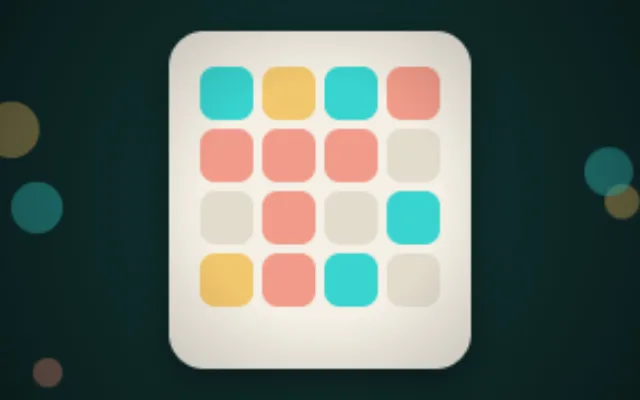
The most influential visual invention of the period is tiny. At the end of a daily word game released in October 2021, you could copy your result as a grid of coloured square emoji: one row per guess, green for a right letter in the right place, yellow for a right letter in the wrong place, grey for a miss. The grid shows the shape of your game without revealing a single letter. It can be pasted into any chat on any phone, and it reads at a glance. It is a high-score table, a story and a spoiler shield in one image, and it was copied by almost every daily game that followed.
Colour carrying meaning raises an old accessibility problem, because green and yellow can be hard to tell apart for many colour-blind players. The better daily games added a high-contrast setting with a different pair of colours, and some added shapes or patterns as well as colour. It is a good rule for any game: never let colour be the only signal.
The browser grows up again
On the last day of 2020 the old plugin that had powered the Flash Hall reached the end of its support, and browsers removed it soon after. By then it hardly mattered for new games. The open web standards described in earlier halls could already do everything the plugin had done, and more. WebAssembly let compiled engines run in a tab, and in 2023 a major browser shipped WebGPU, a new interface that gives web pages modern access to the graphics chip. A game that once needed a download could be a link again.
Sound in daily games was often nothing at all, because they were played on commutes and in waiting rooms and under the desk. When there was sound, it was a soft tick for each tile, a gentle chord for a solve, and a mute button that remembered your choice.
The input
The controls of the daily puzzle are the oldest in this museum: a keyboard. Sometimes it is the real one, sometimes a row of letters drawn on the screen, but the act is typing a guess and pressing enter. Other daily games ask you to drag a path through a grid, tap four words that belong together, or slide a tile one square. None of them needs speed. They need thought, and they give you all day to have it.
That is a big change from the reflex tests of the earlier halls. A daily puzzle is turn-based in the most generous sense: the game waits as long as you need, and the only clock is midnight.
Move, and let the rest happen
At the opposite end of the period sits a genre with the simplest controls since the one-tap years. In December 2021 a solo developer released, in early access and at a very low price, a gothic survival game in which you only walk. Your character attacks on its own; you choose where to stand and which upgrade to take each time you level up. Within minutes the screen fills with hundreds of enemies and a storm of your own projectiles. Players called the result bullet heaven, as the cheerful opposite of the bullet-hell shooters where the screen is full of danger aimed at you. Dozens of games in the same shape followed within a few years.
Drag, drop, merge
Merge games turned the satisfying moment of combining two things into a whole genre. On phones, merge puzzles asked you to drag two matching items together to make a better one. A physics version, in which you drop fruit into a jar and two of the same kind fuse into the next size up, was first released in Japan in 2021 and became an international hit in 2023. The control is one drop at a time; the skill is predicting how a pile will settle.
The room
The room, in 2020, was home. For months much of the world was told to stay indoors, and games became a place to meet. Friends who could not visit one another gathered on video calls to play party games, families kept in touch on island-building and life-simulation games, and many people who had not played for years started again. Sales and player numbers rose sharply across the industry during that year.
Everyone gets the same puzzle
Out of that period came the daily-puzzle boom. The word game with the coloured grid was made by one software engineer as a gift for his partner, released to the public in October 2021, and spread through group chats over that winter, largely because of the shareable grid. In early 2022 it was bought by a major American newspaper, which already ran one of the most famous crossword puzzles in the world, and in 2023 the same paper launched a daily game about sorting sixteen words into four hidden groups.
Newspapers were the natural home for this, because daily puzzles are much older than video games. The first crossword is usually dated to a New York newspaper in December 1913, and papers have printed a puzzle a day ever since. What the 2020s added was the shared result and the knowledge that everyone you know is solving the same grid today. A puzzle a day is also a puzzle a day: when you are done, you are done. That limit, which a business built on time-in-app would never choose, is part of why people love it.
Variants appeared by the hundred: guess the country from its outline, the song from its first second, the number from a sum, the film from a frame. Many were made by one person in a weekend, hosted as a simple web page, and shared by link. It was the io-game pattern again, but slower and gentler.
Cozy
A second strand of the period was the cozy game. The word came into wide use for games about gardening, farming, decorating, cooking, tidying or looking after creatures, where there is little or no failure and the pleasure is in making a small place nicer. Cozy games had existed for decades, but the years at home made them a named genre with its own shelves, festivals and fans. Their design rules are worth stating plainly, because they are also kind rules: no punishment for leaving, no clock that nags, no loss that undoes an evening’s work.
The business, briefly
Much of the big-budget industry moved from random paid boxes toward the season pass, where a visible list of rewards is unlocked by playing over a few months. Subscription libraries and streaming from the cloud gave players new ways to reach large games. Regulators kept looking at paid randomised items. None of that is our business here. Eracade sits where the daily puzzle and the old arcade meet: free to play, one link, a fair board, and nothing for sale that changes a score.
Three design ideas we borrowed
One puzzle, the same for everyone
Letterlock gives you six tries to find a hidden five-letter word, with green tiles for letters in the right place and amber for letters in the word but somewhere else. The daily set is identical for every player, which turns a private puzzle into a conversation. The design idea is a limit as a gift: everyone gets the same day, and the day ends.
Make the combining feel good
In Pebble Jar you drop pebbles into a jar, and two the same size that touch merge into the next size up. Keep the pile under the rim. Merge games of this period made one physical moment, two things becoming one, so satisfying that you could build a whole game on it, and the physics turns every drop into a small prediction.
Take away the trigger
Ember Horde walks a lantern-bearer through eight minutes of shadow-moths. Your fire fires itself, and every level-up offers three upgrades to choose from. Taking the trigger away moves the game into your feet and your choices. We made one change of our own: your light is your health, so getting stronger and staying safe are the same thing.
Where the era is going
This hall has not ended, and it would be odd to pretend otherwise. We are writing in October 2026, and the habits of the 2020s, one shared puzzle, a calm screen, a result you can paste, a game that is happy to be a web page, are still in full swing. When something new arrives, we will add a hall for it.
What we can say is what this period handed back to everyone. The browser is a games machine again, and the oldest promise of the web, a link that opens straight into play, is as strong as it was in the Flash years. Small games made by one or two people can still become everybody’s game for a winter. And a game that respects your time, that is happy for you to stop, turns out to be one people return to every day.
That is the spirit of this whole arcade, and the reason the museum ends here, in the present, with the lights still on.
Further reading
Outside links are chosen for being stable, general and free to read. We link; we do not copy.
- Crossword (Wikipedia) The daily puzzle's long newspaper history, from 1913 on.
- Wordle (Wikipedia) The 2021 word game and its shareable grid of coloured squares.
- Cozy game (Wikipedia) What the term means and how the genre grew.
- Impact of the COVID-19 pandemic on the video game industry (Wikipedia) Games as meeting places in 2020.
- WebGPU (Wikipedia) The browser's modern interface to the graphics chip.
- Flashpoint Archive Volunteers preserving the web games that came before.
Play the history
Every playable cabinet on Eracade from the Daily Puzzle years, sorted by kind. They are our own originals and credited revivals, made in the spirit of the hall you have just walked through.
Idle
Arcade
Action
Word
Puzzle
- Ninefold Play
- Pebble Jar Play
- Postcard Puzzle Play
- Equate Play
- Pixel Proof Play
- Triplet Tray Play
- Alchemy Shelf Play
- Daily Labyrinth Play
- Numpath Play
- Shelf Sort Play
- Codebreak Hues Play
Strategy
Rhythm
Trivia
Adventure
Mystery
Stamp this hall
If you have read this far, take a stamp for your Passport. It is saved in this browser only, next to your game stamps, and nothing is sent anywhere.
Spotted a mistake? Send a correction to hello@eracade.com.