Read this first. Everything here is original writing. There are no screenshots, sprites, logos or box art from real games, and facts are stated in general terms. How we work.
The glass
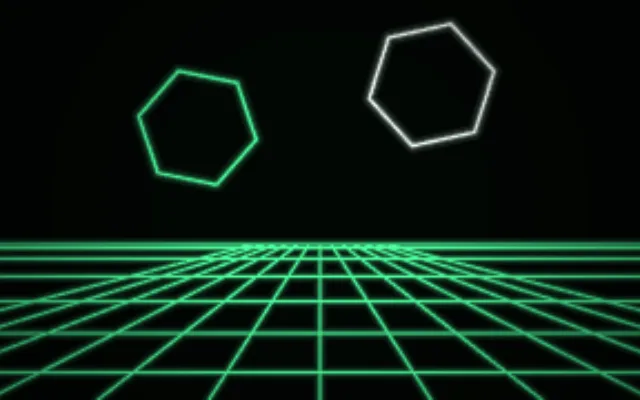
A television builds a picture the way a typist fills a page: left to right, top to bottom, sixty times a second, one scan line at a time. A vector monitor does something stranger. It has no grid and no fixed order. A beam of electrons is steered by magnetic coils, aimed at a point on the back of the glass, and then dragged to another point. The phosphor lights up along the path. That path is the line. Nothing else is drawn, because nothing else is there.
The machine behind the tube did not store a picture. It stored a short list of instructions: move to here, draw to there, make this stroke brighter, make that one dim. A circuit read the list in a loop, steered the beam through it, and started again. Every shape you saw was a handful of numbers, which is why a spinning wireframe ship cost almost nothing in memory and why the lines were so clean. There was no staircase on a diagonal, because there were no steps to climb.
Why it glowed
The phosphor on the inside of the tube keeps shining for a moment after the beam leaves it. On a vector display that afterglow is the whole image: a line that the beam has not revisited yet is already fading. Draw too many lines and the beam cannot get round the list in time, so the picture flickers and the last items in the list look dimmer than the first. Designers learned to count their lines the way a poet counts syllables. A rock with eight sides was a luxury. A ship with five lines was a bargain.
Overlapping strokes are brighter where they cross, because the beam visits that spot more than once. Fast strokes look thinner and fainter than slow ones, because the beam spends less time on each bit of phosphor. A single dot, held still, burns brightest of all. These are not special effects. They are the physics showing through, and it is the look people still try to copy with glow filters and additive blending.
Colour, mostly by trickery
Most vector cabinets showed one colour of light, usually a white or green phosphor. Colour came from the room: a sheet of tinted plastic laid over part of the screen, or a painted backdrop reflected in a mirror so that a glowing ship seemed to fly over a printed planet. Later in the period, colour tubes were adapted to the vector method, with separate brightness for each of three beams. They were expensive, fiddly to keep aligned, and short-lived in the field. The monochrome tube kept its reputation for being the clean, sharp one.
What it could not do
Filled shapes were the weak spot. A vector display can only trace outlines cheaply, so a solid wall or a field of grass means drawing hundreds of tightly packed lines, and the flicker returns. Text was drawn as strokes too, which is why lettering from this time looks like it was written with a stick. Raster hardware, meanwhile, was getting cheaper every season, and it could fill the screen with colour without breaking a sweat. We will come to that. For a few years, though, nothing else had the same cold, bright, mathematical look.
In the same years the first cheap home consoles used ordinary raster television sets and had to build each picture a line at a time with almost no memory. Programmers on those machines spoke of racing the beam: changing the hardware’s settings in the instant between one scan line and the next. It sounds like the opposite of vector drawing, and in a way it was, but both groups shared one habit. They designed around what the glass could physically do and made the limit the style.
The input
Vector games of the period were mostly about momentum, and the controls were built to carry it. A typical cabinet gave you a small cluster of buttons: rotate left, rotate right, thrust, fire, and sometimes a panic button that threw you to a random spot on the screen. You did not steer a ship so much as persuade it. Turn, burn, let go, and watch it keep drifting in the old direction while you aimed somewhere else. That gap between what you point at and where you are going is the entire game.
Other cabinets used a knob that spun freely. A knob has no end stops and no centre position, so it can be read as speed and direction at once, and it feels wonderful under the palm. Paddle controllers worked the same way for the bat-and-ball games that came before: a dial wired to a variable resistor. Trackballs, a heavy ball in a cradle, started to show up in arcades toward the end of the decade and asked for a different skill, a flick and a catch.
Home computers of the time put a keyboard in front of you and hoped for the best. Games borrowed keys in pairs, one for left, one for right, with a space bar for everything else. That is the origin of the arrangement your fingers still fall into without being asked. The joystick on a home console was a single stick with a single button, so even a deep game had to be playable with one hand and one thumb.
One button, many verbs
With so little to press, designers made each control do several jobs. Thrust could also be a risk, because the engine’s glow gave away your position. Fire could be limited to four shots on screen at once, which turned a trigger into a rhythm. The scarcity of controls is the reason these games can be explained in a sentence, and the reason a good one still takes a year to master.
The room
Picture the room. It is dim, because the cabinets are the only light worth having, and slightly loud, because every machine is playing its attract mode to nobody in particular. The carpet is patterned to hide whatever happens to it. There is a smell of warm electronics, pizza, and a floor cleaner nobody could name. A cabinet stands about as tall as a refrigerator, with a slanted control panel at waist height and a monitor hooded against reflections.
These rooms were not only called arcades. A vector cabinet might live in a bowling alley, a pizza restaurant, the foyer of a cinema, a bar, a ferry terminal, a laundrette or the back corner of a corner shop. Wherever people waited with coins in their pockets, a screen glowed. For many players, that was the whole of computing: a few minutes, a coin, and a cabinet that played with them until they lost.
The score table was the social network. Three initials, a number, and a place on the list that every stranger who followed would see. Nobody could prove who you were, which is exactly why the three letters mattered. They were a signature scratched into a public wall. You returned to see whether it was still there.
At home, a television set the size of a bread bin sat on a stand, a console was plugged into it with a switch box, and the whole family’s patience was the real memory limit. Computer labs and offices held a few early machines, and some of the sharpest programming of the age happened in borrowed hours on those. Magazines printed games as long lists of numbers that you typed in over an evening, and the first reward was the scolding when you made a typo.
Everything about the setting made play short and public. You played where others could watch, you played until you died, and you handed the cabinet over. That is the shape our games still inherit: a run you can finish in the time it takes a bus to arrive, and a score that means something because someone else can see it.
Three design ideas we borrowed
Inertia is character
A ship that keeps moving after you stop pushing has a personality. You learn it the way you learn a bicycle. Tether Drift takes the idea one step further by hanging a heavy slug on an elastic line behind you, so there are two bodies to read at once, and the line will snap if you wrap it round a pylon. It is the oldest trick in the room, with one more string attached.
Draw only what matters
When every line costs something, every line has to mean something. Phosphor Parry has a reactor, a shield arc and incoming shards, and the screen is otherwise left to the dark. The thing that you can hit and the thing that can hit you are the only things drawn, which makes the danger easy to read at a glance and the glow look earned.
Let motion carry meaning
The bat-and-ball games of the period let the paddle’s own movement change the ball’s path. In Vector Volley, how fast you are moving when you touch the ball matters as much as where. Nobody has to explain it, because your hand already understands. The best controls in this era did not add rules. They made physics legible.
Games from this era on Eracade
- Vector Volley Play
- Phosphor Parry Play
- Filament Run Play
- Tether Drift Play
- Orbit Tether In the workshop
- Wickmaze In the workshop
What ended the era
Vector hardware ended the way many good things do: it became inconvenient. The high-voltage deflection circuits needed skilled repair, the tubes drifted, and the cabinets were heavy and costly to build. Raster screens, on the other hand, were mass-produced for televisions, could show colour and filled shapes, and could be backed by cheap memory that held a whole picture at once. Designers who wanted characters, mazes and bright cartoon colour had no reason to stay with outlines.
The gold rush that followed brought new rooms, new money and a great many imitators. Vector graphics did not vanish overnight; a few strong cabinets kept appearing into the mid-1980s. But the centre of gravity moved to the sprite, and the next hall is about that. The vector look went from technology to taste, and it has been revived ever since for exactly the reasons it first worked: it is clear, it glows, and it looks like a machine thinking.
Further reading
Outside links are chosen for being stable, general and free to read. We link; we do not copy.
- Vector monitor (Wikipedia) The mechanism and the history of vector displays in general terms.
- Cathode-ray tube (Wikipedia) How the electron gun, deflection and phosphor fit together.
- Golden age of arcade video games (Wikipedia) A broad overview of the period around this hall.
- Game controller (Wikipedia) Paddles, joysticks, trackballs and how they are read.
Stamp this hall
If you have read this far, take a stamp for your Passport. It is saved in this browser only, next to your game stamps, and nothing is sent anywhere.
Spotted a mistake? Send a correction to hello@eracade.com.